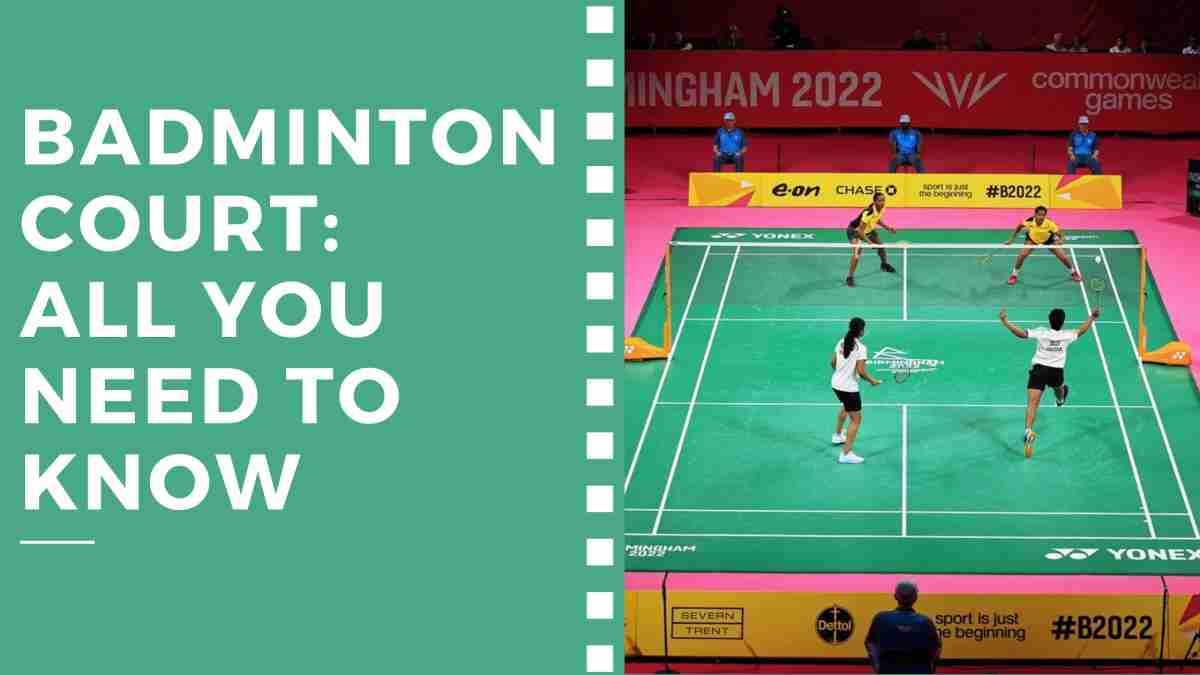
Badminton is an exciting sport. The shuttle flying from one half to the other at a rapid pace makes for gripping gameplay, isn’t it?
But it’s the shuttlers who are always on their toes. They need to be precise in their judgement while attempting strokes on the rectangular court.
Thus, it becomes important for a shuttler to be aware of the surface they are playing on. And if you are someone who is a beginner in the sport or a fan, then you must know everything about badminton courts.
In this article, let’s understand the badminton courts up close, including their dimensions and different playing surfaces.
So what are the dimensions of a badminton court?
See, the Badminton World Federation (BWF), which governs the sport, has set regulations in terms of the playing surface dimensions.
A standard badminton court is 13.40 meters (44 feet) in length and 6.1 meters (20 feet) in width. The court is rectangular in shape and the surface measures 14.72 meters diagonally.
The court is further divided into two halves, with 6.7 meters (22 feet) length on both sides. A net stands in the middle of the court, which is 1.55 meters (5 feet 1 inch) in height on both ends and 1.52 meters (5 feet) in the centre.
The two halves are further drawn into two sections of 3.88 meters (12.72 feet) in length and 2.53 meters (8.3 feet) in width. These sections are known as service areas, and a standard court has four such areas.
The shuttlers serve the shuttle by standing inside these markings, with the short service line close to the net at 1.98 meters (6.5 feet) and the long service line close to the baseline at 0.72 meters (2.36 feet) towards the back of the shuttler.
Are badminton court dimensions the same for singles and doubles contests?
The badminton court dimensions mentioned above remain the same. The length is the same, but the width varies for singles and doubles contests.
For doubles, the standard court dimensions apply as they are, with double sidelines. But for singles, the width shrinks, measuring 5.18 meters (17 feet) marked by the inner sidelines.
Also Read | Tennis Grand Slam Tournaments – Explained
What are these lines on the badminton courts?
You can see a few lines marked on the badminton courts, which denote the playing area.
Service Lines
Shuttlers can make their serves from the two lines marked on the surface. The short service line is close to the net, while the long service line is close to the baseline.
Baselines
The baselines are at the ends of both halves. Their width differs according to the singles and doubles contests, but they are situated 13.40 meters apart.
Inner Sidelines
The inner sidelines run along the length of the court, while they are 5.18 meters wide. These inner sidelines determine the playing area for singles matches, with the shuttle landing outside the inner sideline considered out of play.
Outside Sidelines
As the name suggests, the outer sidelines are outside the inner sidelines with a gap of 0.46 meters between them. They are 13.40 meters long and 6.1 meters wide, with the shuttle falling outside of it being invalid.
For a shot to be considered ‘in’, it needs to land within the baseline and inner sidelines for a singles match, while it must fall inside the baseline and outer sidelines for a doubles match.
If the shuttle falls outside, then it’s deemed out of play. Think of inner-outer sidelines and baselines as the boundaries of the playing area.
Does the badminton court size differ for all levels?
Well, the answer is no. The standard dimensions mentioned above are similar across all levels, be it junior-level matches or even the badminton games played in the Olympics.
What are the different playing surfaces in badminton?
There are two types of common playing surfaces in badminton: wooden and synthetic.
The wooden surfaces are made up of hardwood, which can sustain the movement of shuttlers. But the surface may become slippery if a player’s sweat drops on it. So it poses a challenge for players, and they might lose their grip.
Synthetic surfaces, on the other hand, are quite common these days. They are made up of PVC or PU, which are laid on a wooden floor.
The synthetic surface provides cushion to shuttlers as they are softer than wood, reducing strain on their lower body. Plus, they are not much slippery, providing excellent grip to the shuttlers.
Read Next | Ten Iconic Football Stadiums in the World