
If you are about to play your first game of chess, this is your complete rule-by-rule walkthrough. There is no history, no fluff — just how to set up the board correctly, how every piece moves, and exactly what you are legally allowed to do on your turn.
Setting Up the Board Correctly
Before a single move is made, the board must be oriented properly. The golden rule is “white on the right” — the light-colored square in the bottom-right corner must be on each player’s right-hand side. If the board is rotated incorrectly, every coordinate and piece placement that follows will be wrong.
The most common beginner mistake is placing the Queen on the wrong starting square. Remember “Queen on her own color” — the White Queen starts on a light square, and the Black Queen starts on a dark square. The King stands directly next to her.
The remaining pieces mirror each other outward from the center: Bishops next to the King and Queen, then Knights, then Rooks in the corners. A full row of Pawns stands directly in front of all of them.
How Each Piece Moves
Every piece has a strictly defined movement pattern. With the single exception of the Knight, no piece can jump over another piece that is in its path.
| Piece | Movement Pattern | Can it jump? | Special Notes |
| King | One square in any direction | No | Cannot move into a square that is under attack (check). |
| Queen | Any number of squares in any direction | No | The most powerful piece on the board. |
| Rook | Any number of squares horizontally or vertically | No | Involved in the special “castling” move alongside the King. |
| Bishop | Any number of squares diagonally | No | Stays on its starting color (light or dark) for the entire game. |
| Knight | An “L” shape (two squares in one direction, then one perpendicular) | Yes | The only piece that can hop over others. |
| Pawn | One square forward | No | Moves straight forward but captures diagonally. Can move two squares on its very first move. |
Special Moves Beginners Always Get Wrong
Beyond standard movement, chess has three special rules that consistently catch new players off guard.
Castling
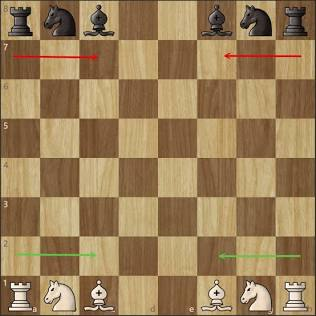
Castling lets you do two things simultaneously: move your King to safety and bring a Rook into active play. The King moves two squares toward a Rook, and that Rook hops over the King to sit directly beside it on the other side.
There are two types:
- Kingside castling (short castling) — King moves toward the Rook on the h-file
- Queenside castling (long castling) — King moves toward the Rook on the a-file
All of the following conditions must be met:
- It must be the first move ever for both the King and the specific Rook being used
- There must be no pieces standing between them
- The King cannot be in check at the time of castling
- The King cannot pass through a square that is under attack
- The King cannot land on a square that is under attack
En Passant
En passant (French for “in passing”) is a highly specific Pawn capture that most beginners never learn until they are caught out by it mid-game.
If your opponent moves a Pawn two squares forward from its starting position and it lands directly beside your Pawn, you have exactly one opportunity — your very next turn — to capture it as if it had only moved one square. Your Pawn moves diagonally behind the enemy Pawn and removes it from the board.
If you do not play en passant on that immediate turn, the right to do so is permanently lost.
Pawn Promotion
If a Pawn successfully reaches the opposite end of the board (the 8th rank for White, the 1st rank for Black), it must be immediately promoted to another piece. The Pawn cannot remain a Pawn.
You may promote to a Queen, Rook, Bishop, or Knight — regardless of how many of those pieces are already on the board. Promoting to a Queen is by far the most common choice, but promoting to a Knight (called underpromotion) is occasionally the correct tactical decision.
Check, Checkmate, and Stalemate

Understanding when a game is over — and exactly why — is the most critical ruleset for any beginner.
- Check: Your King is under direct attack by at least one enemy piece. It is illegal to ignore a check or make a move that leaves your King in check. You must immediately resolve it by moving the King, blocking the attack with another piece, or capturing the attacking piece.
- Checkmate: Your King is in check and there is absolutely no legal move available to escape it. The game ends immediately. The player who delivered checkmate wins.
- Stalemate: It is your turn to move, your King is not in check, but you have no legal move available anywhere on the board. The game ends immediately as a draw — not a win for the attacking player. Stalemate is one of the most important defensive resources in losing endgames and a frequent source of confusion for beginners
Illegal Moves and the Touch-Move Rule
You cannot make any move that places or leaves your own King in check. If an illegal move is made, it must be retracted and replaced with a legal one.
In club and tournament settings, the touch-move rule applies and is strictly enforced:
- If you intentionally touch one of your own pieces, you must move that piece if it has a legal move available
- If you touch an opponent’s piece, you must capture it if it is legally possible to do so
- Once you release a piece on a square, your turn is over — the move cannot be taken back under any circumstance
How a Game Legally Ends
A chess game concludes in one of the following ways:
- Checkmate — The King is in check with no legal escape. The attacking player wins.
- Resignation — A player voluntarily concedes the game to their opponent, typically when the position is beyond saving.
- Stalemate — The player to move has no legal moves and their King is not in check. Immediate draw.
- Threefold repetition — The exact same board position (including which player is to move and castling/en passant rights) occurs three times in a game. Either player may claim a draw.
- 50-move rule — If 50 consecutive moves pass with no Pawn move and no capture, either player may claim a draw.
- Agreed draw — Both players mutually agree to end the game in a tie at any point during play.
For tournament scoring — how wins, draws, and losses convert into points across an event — see our Ultimate Beginners Guide to Chess.
Quick-Reference Rule Guide
Screenshot this table to keep by your side during your first few games.
| Concept | Rule Summary |
| Piece Values | Queen (9), Rook (5), Bishop (3), Knight (3), Pawn (1). The King has no numerical value as it cannot be captured. |
| Check vs Checkmate | Check = King is attacked but can escape. Checkmate = King is attacked and cannot escape (Game Over). |
| Stalemate | King is NOT attacked, but the player has no legal moves (Draw). |
| Castling Limits | Cannot castle out of check, through check, or into check. |
| Pawn First Move | Can move 1 or 2 squares forward. |