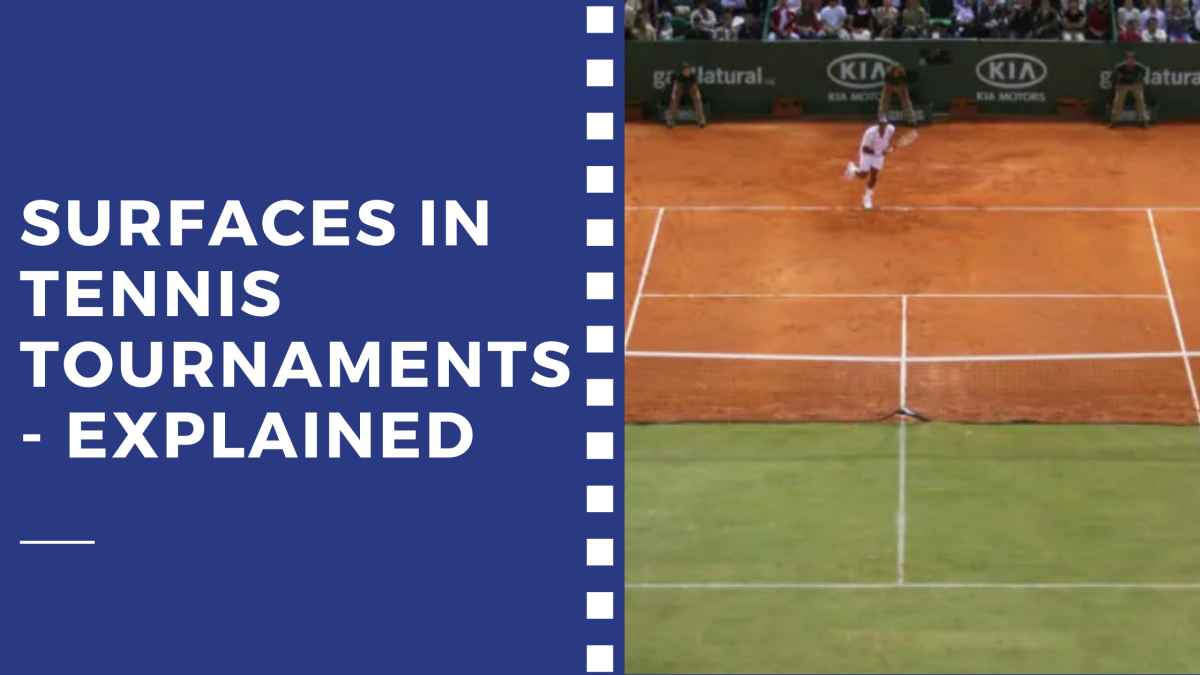
Tennis is among those few sports that are played across several surfaces. It has a global appeal for this very reason, given that players have to adapt to different conditions and surfaces at different intervals to ensure that they get on top of the game and bag as many points as possible.
Only those players who are able to adapt and adjust according to every condition and surface can succeed at the highest level and that too, consistently. However, history has shown that not every player is able to succeed in every condition, and most of them have a preferred surface.
This comes due to the natural conditioning of the players — both physical and mental — and allows them to adapt to the surfaces that they feel they can acclimatise themselves best at. It also allows them to prepare to know what they like best and change their mindset in accordance with the challenges brought on board by each.
The three main surfaces used in tennis are grass, clay, and hard courts. Initially, tennis was only played on grass, which is why the technical name of the sport is lawn tennis.
However, this changed later to adapt to different surfaces in different countries as clay and hard courts were introduced. While clay courts became popular during the late 1800s, hard courts emerged in the arena by the 1930s as an alternative to grass. The latter are created artificially by using concrete.
The Four Majors are Played on Different Surfaces
The four major tournaments in tennis — the Grand Slams — are all played on different surfaces. While the Australian Open, with whom the year begins in January, is played on a hard court, the French Open, which takes place next in May-June, is played on a clay surface.
Wimbledon, which is held almost immediately after the French Open, is the only major tennis tournament that is still played on grass. The US Open, which is the last major of the year, takes place in August-September and is played on a hard court.
Very few players have emerged in tennis who have been able to master all three surfaces with ease. It has become apparent over time that even the best have favourite surfaces on which they adapt better and play more comfortably.
While artificial hard courts are known for their even carry and bounce, clay surfaces are notorious for seeing the ball stop a tad and come onto the racquet. The amount of topspin on the ball is also much more on clay courts.
Grass, which is the traditional surface where tennis is played, is known for skid and bounce as well as even carry into the players’ racquets and encouraging an even game. This is how tennis was conventionally played and how a lot of purists still view the game to be as. Clay and artificial courts were introduced only to ease the burden on the grass courts.
What does each surface do?
As we have explained above, each surface plays differently and tests different skill sets of the players involved.
Grass, which is the traditional surface on which tennis is played, is known to have even bounce, although the length of it can sometimes bring in a bit of variation. This variable bounce tests the players’ patience and willingness to wait it out until they get on top of their shots and are extremely confident of playing them.
Clay, on the other hand, aids a lot of topspin, which means that players have to wait for a split second after the ball bounces to play their shots.
The topspin on clay means that the ball can go either way after bouncing, and if a player decides to go through with their shot too early, they will end up mistiming it and perhaps even hitting it into the net. If the player hits the shot too early, the ball is bound to go out of the court, while if they hit it too late, they might end up hitting it into the net.
All artificial surfaces, which include the hard courts found in Australia and the USA, aid good bounce and carry of the ball. On these surfaces, the players can trust their shots blindly and play them as they would in practice on a concrete surface.
What works in the favour of hard courts is that they dry up quickly after it rains, and true to its name, natural conditions play very little role here.
Players are predominantly tested on their fitness and technique on hard courts, whereas clay and grass are dependent on natural conditions. Even a slight drizzle can alter the state of the court on the latter two surfaces, and it is the player who adjusts and adapts the best who is bound to come out on top.
Read Next | ATP Tours – Explained