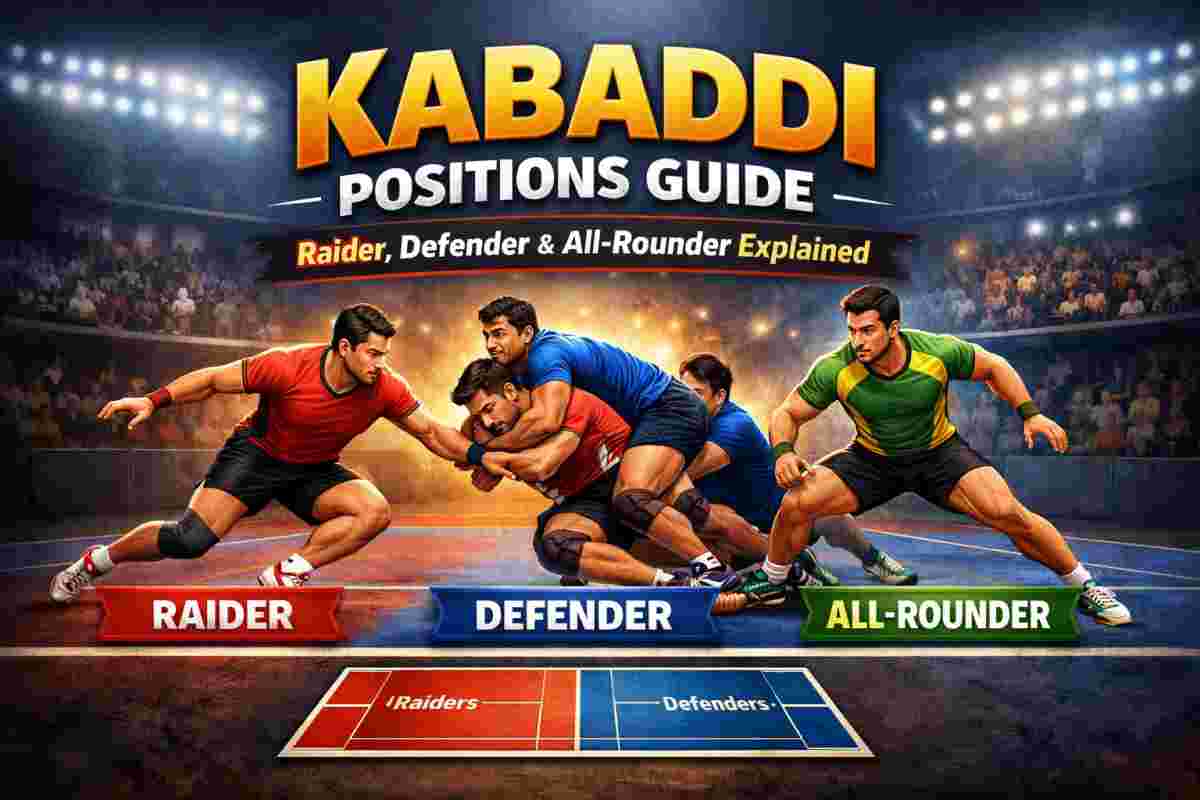
Kabaddi is a high-speed combat sport where one player invades enemy territory while seven opponents try to stop them without letting them escape. Every team is built around three positional archetypes: raiders who attack, defenders who trap, and all-rounders who balance both roles.
Understanding these three roles unlocks the entire logic of Kabaddi.
What Are the Main Positions in Kabaddi?
Kabaddi teams are structured around three primary roles: raiders, defenders, and all-rounders. Raiders score points by tagging opponents and returning safely. Defenders stop raiders through coordinated tackles. All-rounders do both, offering tactical flexibility and balance.
In professional leagues like the Pro Kabaddi League, team composition often revolves around 2–3 primary raiders, 4–5 specialist defenders, and 1–2 versatile all-rounders.
Read: Kabaddi Rules Explained: Raid, Do-or-Die, and Bonus Points
What Does a Raider Do?
A raider is the attacking spear of a Kabaddi team. Their job is to cross into the opponent’s half, tag defenders, and return before being tackled—all while continuously chanting “kabaddi” to prove they are not inhaling.
One breath. One mission.
Raider Responsibilities
- Enter the opponent’s half
- Tag defenders with hand, foot, or body
- Escape back to the midline
- Score points for each defender touched
If caught? Point to the defense.
Key Raider Skills
- Agility – lightning-fast footwork
- Body control – escaping tackles
- Awareness – reading defensive formations
- Deception – fakes, sudden turns, and hesitation moves
Famous Raiders
Some of the greatest raiders in modern Kabaddi include:
- Pardeep Narwal – famous for the “Dubki” escape
- Rahul Chaudhari – known as the “Showman”
- Anup Kumar – master of calm strategic raids
Raiders are the crowd magnets. Every raid is a miniature duel.
What Does a Defender Do?
A defender is the wall. Their mission is to stop the raider from escaping by executing coordinated tackles.
Timing matters. One mistake means a point conceded.
Defender Responsibilities
- Guard specific zones of the court
- Track raider movements
- Coordinate tackles with teammates
- Force raiders into mistakes
Key Defensive Techniques
1. Ankle Hold
A defender grabs the raider’s ankle to stop forward movement.
2. Thigh Hold
A powerful grip around the raider’s upper leg.
3. Block
Using body mass to stop the raider’s path.
4. Dash
A sudden push sending the raider out of bounds.
Defensive Positions on the Court
Typical defensive roles include:
- Corners – strongest tacklers
- Covers – support defenders
- Ins – central support
Elite defenders include:
- Fazel Atrachali
- Manjeet Chhillar
- Surender Nada
Defenders operate like a pack.
One moves. All move.
What Is an All-Rounder in Kabaddi?
An all-rounder is the rare athlete capable of both raiding and defending effectively. They are tactical glue—able to shift roles depending on match conditions.
Why Teams Value All-Rounders
All-rounders give coaches flexibility:
- Attack when the team lacks raiders
- Strengthen defense during critical moments
- Maintain balance during player substitutions
Skills of Great All-Rounders
- Balanced strength and agility
- Strong tactical awareness
- Ability to read match momentum
- High stamina
Famous All-Rounders
Legendary examples include:
- Deepak Niwas Hooda
- Rajesh Narwal
They are the chess pieces that can move anywhere.
Conclusion: The Balance That Defines Kabaddi
Kabaddi is ultimately a game of balance between offense and defense, embodied in its three core positions: raider, defender, and all-rounder. Raiders bring aggression and scoring power. Defenders provide structure and resistance. All-rounders connect both worlds, giving teams the flexibility to adapt as the match evolves.